
California’s Wolf Comeback Continues: At Least 25 Pups Confirmed Across Five Packs
By Ariya Prasad
Volunteer, Women for Wolves
September 2026
California’s wolf recolonization has reached another milestone. As field assessments continue across Northern California, the California Department of Fish and Wildlife (CDFW) has confirmed reproduction in multiple established packs for 2026. Through trail cameras, visual observations, and other monitoring methods, researchers have documented at least 25 new pups across five packs.
The Whaleback Pack in Siskiyou County had at least nine pups, while the Ashpan and Whitehorse packs each had at least five. The Harvey Pack had at least four pups, and the Lassen Pack had at least two. After wolves were eradicated from California in the 1920s, they began returning naturally to the state in 2011. Today, California has at least 11 confirmed wolf packs.
For biologists and conservation advocates, these numbers are encouraging. They also raise an important question about the next stage of wolf recovery: how can California support wolves’ return while helping the communities that live alongside them?
What the Science Tells Us About Recolonization
Gray wolves can travel hundreds of miles across rugged terrain in search of open territory and unrelated mates. Their continued growth in Northern California suggests that parts of the region provide the habitat, connectivity, and prey needed for wolves to establish packs and raise young.
As apex predators, wolves can influence the ecosystems around them. Research in places such as Yellowstone has examined how wolves can affect prey populations and behavior, with effects that may extend to other parts of the ecosystem. Wolf kills also provide food for scavengers, including bald eagles, ravens, and other wildlife.
Still, wolf populations do not grow in a straight line. Pack sizes can change because of territorial conflicts, pup mortality, food availability, disease, dispersal, and human-caused mortality. Mange, for example, has affected members of California’s Yowlumni Pack.
The Realities of Coexistence
As California’s wolf population grows, encounters with livestock may become more common. For ranchers and rural communities, those encounters can carry real economic costs.
Preventing conflict requires practical, nonlethal strategies that can be adapted to local conditions:
Range Riders: Herd monitors maintain a regular presence, look for signs of wolves, and identify risks early.
Fladry: Flagging, including electrified fladry in some applications, can help temporarily discourage wolves from approaching livestock.
Guardian Animals: Livestock guardian dogs and other guardian animals can help protect herds as part of a broader coexistence strategy.
Carcass Management: Removing livestock carcasses and other attractants can reduce opportunities for wolves to associate livestock areas with food.
State Compensation and Prevention Funding: Reimbursement for eligible livestock losses and funding for preventive measures can help ranchers manage costs and reduce conflict.
None of these measures works on its own in every situation. Successful coexistence takes resources, patience, and collaboration among ranchers, conservationists, Tribes, researchers, and wildlife managers.
Studying Wolves Without Disturbing Them
Researchers can study how wolves adapt to California’s landscapes and human activity while minimizing disturbance. Trail cameras and noninvasive genetic sampling can help scientists document wolf presence, reproduction, genetic relationships, and movement across the landscape.
DNA collected from hair and scat can help researchers identify individual wolves and better understand relationships among packs. Wildlife managers also use GPS and VHF collars to gather information about wolf movements and territory use.
Together, these methods give researchers and wildlife managers a clearer picture of how California’s wolf population is changing and where wolves are traveling.
Looking Ahead
The return of wolves to California gives us an opportunity to learn how to live alongside a native carnivore that was absent from the state for generations. Long-term conservation will depend on scientific research, community leadership, Indigenous knowledge and stewardship, and practical tools for preventing conflict.
Each new pup documented this season is a sign of recovery. It is also a reminder that protecting wolves means doing the ongoing work of making coexistence possible for the people and wildlife who share the landscape.
Sources & References
California Department of Fish and Wildlife (CDFW). (2025–2026). California Gray Wolf Conservation and Management Reports, Quarterly Updates, and Known Wolves Updates.
Ripple, W. J., & Beschta, R. L. (2012). Trophic cascades in Yellowstone: The first 15 years after wolf reintroduction. Biological Conservation, 145(1), 205–213.
U.S. Fish & Wildlife Service. Gray Wolf (Canis lupus) species information and management resources.
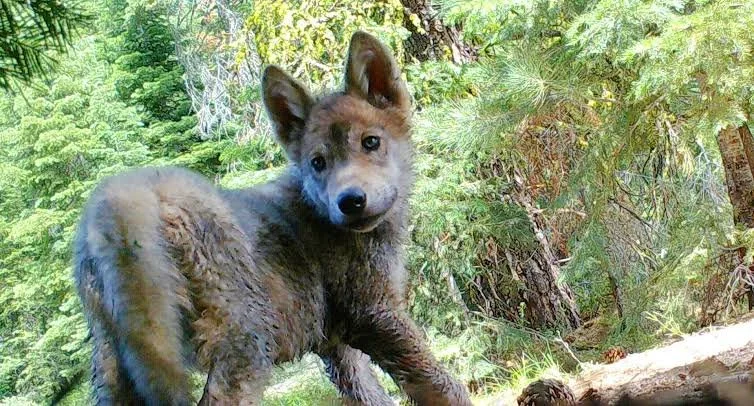
A rare gray wolf couple new to California have mated, producing at least three pups this year, the California Department of Fish and Wildlife said. (U.S. Forest Service)